Electromagnetic actuators
Laminated poles and coils generate attractive force. Pole count, air gap, current, saturation, heat, and force linearization shape capacity.
Magnetic bearings · active rotor control
Active magnetic bearings combine electromagnets, displacement sensors, power electronics, control software, rotor dynamics, and auxiliary bearings into one support system.
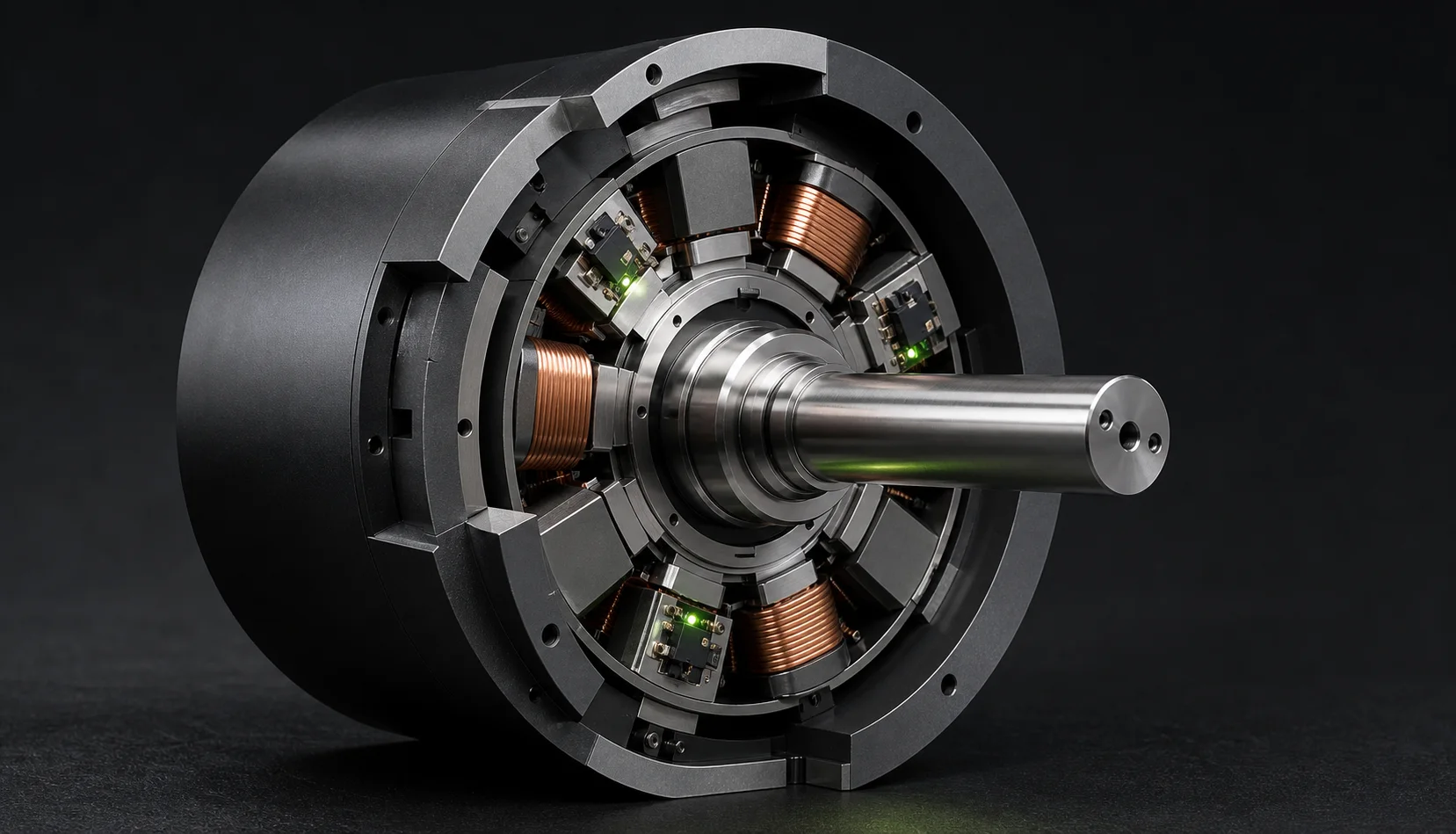
Laminated poles and coils generate attractive force. Pole count, air gap, current, saturation, heat, and force linearization shape capacity.
Eddy-current, inductive, capacitive, optical, or other sensors measure rotor displacement with bandwidth and noise appropriate to the control loop.
Control laws turn measured displacement into coil current while managing stability, vibration modes, saturation, faults, and machine protection.
Rolling, dry-running, or specialty auxiliary bearings catch the rotor during a loss of levitation and absorb a limited number of demanding events.
Permanent magnets can bias force and reduce steady current, but passive magnetic support alone faces stability constraints. Most industrial high-performance systems use active control on the necessary axes and a defined strategy for axial load, disturbance rejection, and shutdown.
| Capability | What it means | System implication |
|---|---|---|
| High-speed operation | No rolling-element centrifugal load or steady contact at the support. | Rotor stress, windage, motor, containment, and critical speeds still limit the machine. |
| Active vibration control | Controller can shape effective stiffness and damping within bandwidth and force limits. | Rotor model, sensor placement, latency, filters, and commissioning become critical. |
| Clean or vacuum service | No bearing lubricant is required in the normal magnetic gap. | Outgassing, cooling, touchdown materials, and motor or process contamination still matter. |
| Condition data | Position, current, orbit, and controller signals expose rotor behavior. | Data quality, storage, alarm logic, and interpretation should be designed in. |
| Adjustable rotor center | Setpoint can sometimes compensate alignment, load, or thermal changes. | Available force, clearance, seal geometry, and protection logic constrain adjustment. |
The auxiliary bearing is not an afterthought. Clearance, rotor drop energy, speed, whirl, contact duration, material, cage behavior, lubrication, heat, rebound, and event count determine whether the system survives a fault without secondary damage.
Compressors, expanders, turbines, and generators with high speed and rotor-dynamic demands.
Oil-free support, clean process boundaries, speed, and controlled touchdown behavior.
Reduced contact wear, condition signals, active vibration response, and process integration.
Low steady loss, vacuum operation, rotor containment, long dwell, and fault protection.
Adjustable support dynamics, orbit measurement, controlled excitation, and flexible commissioning.
Lubricant-free operation where contamination, vacuum, or controlled vibration dominate.
Position sensors measure rotor displacement, a controller calculates corrective forces, and power amplifiers drive electromagnets to keep the rotor centered.
They protect the machine during startup, shutdown, overload, controller faults, power loss, or disturbances beyond the magnetic bearing's force capacity.
The magnetic gap does not need contact lubrication during normal operation. Touchdown bearings and other machine components may still require lubrication or dry-running materials.
No. They can measure and influence rotor motion within force, bandwidth, stability, sensor, and structural limits. The rotor, process, motor, foundation, and controls still set the total vibration behavior.